
How to Check for a Warrant in Hurricane
Hurricane does not publish a city warrant lookup in the reviewed official sources. Start with the city Justice Court for a citation, missed hearing, or payment question; use Hurricane Police for a police report or public-safety record. Keep the citation, case number, legal name, and date of birth available. Ask the court which event will address the warrant before sending payment or relying on an online case entry.
- Read the ticket or notice and identify the issuing court.
- Search Utah's statewide warrant portal for a possible match.
- Check Xchange for public case history using the name or case number.
- Call Hurricane Justice Court to confirm its docket and required next step.
- Contact Hurricane Police for city police records or service questions.
Requesting Hurricane Police Records
Hurricane Police lists its public-safety office and contact information separately from the Justice Court. For records requests, the city identifies records@hurricane.utah.gov; police tips go to policetips@hcpd.utah.gov. A tip email is not a case-status inquiry, and a GRAMA request seeks a record held by the city rather than a judicial decision.
Describe the report or incident as specifically as possible and retain the response. If the question concerns a court date, balance, or bench-warrant recall, direct it to the clerk instead of asking the records inbox to interpret a court order.
The department contact route appears on its official page.
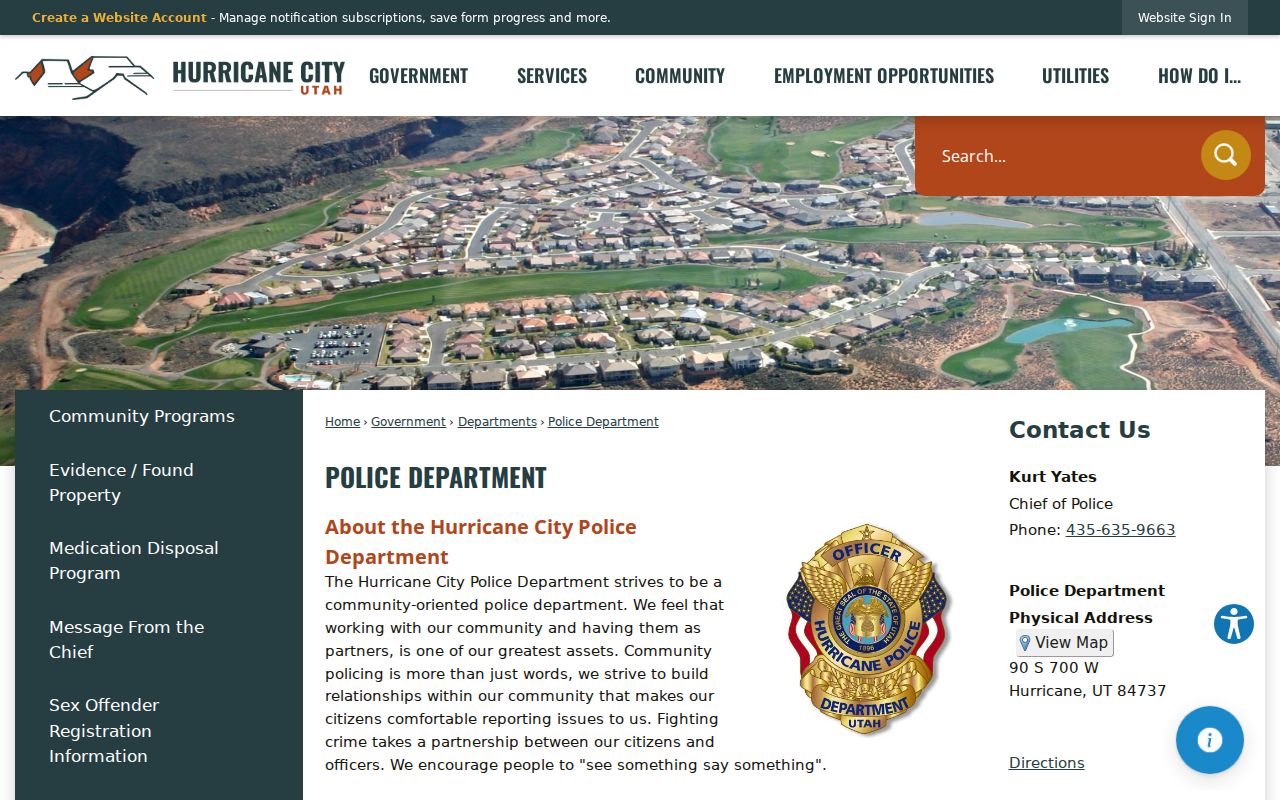
The police page identifies the city agency for a local police-record request.
Hurricane Police and Justice Court Contacts
Hurricane Police handles municipal policing and can answer questions about its own reports. Hurricane Justice Court handles its docket, citation records, hearings, and judicial warrant decisions. The sheriff has a separate county role; these city contacts are the direct route for matters filed in Hurricane's court.
Hurricane Police Department
90 South 700 West, Hurricane, Utah 84737
(435) 635-9663
Records: records@hurricane.utah.gov
Hurricane Justice Court
80 South 700 West, Hurricane, Utah
(435) 635-4072
Ask the clerk about the case and current court schedule.
Hurricane Police Counter Hours
The police department lists public counter hours as Monday through Thursday, 8 a.m. to 5:30 p.m., and Friday, 9 a.m. to 3 p.m. These are the department's posted hours, not a promise that a report will be ready immediately or that a court clerk is available at the same time.
Before traveling, confirm that the records contact can accept the request in person and ask what incident details are needed. The city records email offers a way to describe the request before making the trip.
Hurricane Police Service Context
The city profile identifies 38 full-time police officers serving Hurricane. Staffing context describes the municipal agency, but it does not reveal how many warrants are open or predict how quickly a particular record request will be answered. A public-safety roster is not an individual case-status source.
For an exact case or report, use the incident or citation reference and contact the office that maintains it. The court remains responsible for its docket and warrant orders.
Hurricane Warrant Types
A Hurricane Justice Court case can produce a bench warrant when a defendant misses a required hearing or does not meet a court-ordered obligation. A criminal arrest warrant is a separate judicial order tied to a case investigation. Start with the case caption and issuing court rather than assuming every entry found by a name search belongs to the city docket.
| Warrant Type | How It Arises | Who Issues It |
|---|---|---|
| Traffic bench warrant | Missed traffic appearance or unresolved court obligation | Hurricane Justice Court judge |
| City ordinance case | Failure to respond to a city-filed case | Hurricane Justice Court judge |
| Failure-to-appear order | Missed hearing in an open local case | The court handling that case |
| Criminal arrest warrant | Judicial process based on a criminal matter | Magistrate or court with authority |
Which Hurricane Office Can Change the Case?
Hurricane Police may execute an order or provide a police report, but it cannot replace a court ruling. The Justice Court clerk can explain the case file and arrange the next procedural step; the judge controls whether a bench warrant is recalled or what conditions apply. Ask whether the case requires a judge appointment, payment, or an appearance before acting.
Do not treat a completed web payment, voicemail, or police records response as proof that the court has changed the warrant status. Request confirmation tied to the case number and keep any notice of a new hearing date.
Reading a Hurricane Warrant Record
Compare the case identifier, charge, court, and event date before acting on a search result. The city does not publish a warrant-number format in the reviewed sources, so use the number printed on the citation or court notice. Public case history and a police incident report serve different purposes.
| Case or citation number | Copy it from the Hurricane court document; do not infer a format. |
|---|---|
| Name and date of birth | Use exact identifiers when asking the clerk to locate a file. |
| Charge or violation | Read the filed case description and citation type. |
| Issuing court | Hurricane Justice Court for a city-court matter. |
| Hearing and balance | Confirm dates and amounts with the clerk. |
| Current status | Ask whether the warrant remains active or has been recalled. |
Hurricane's Police and Court Buildings
The Police Department and Hurricane Justice Court are both listed on South 700 West, but they are distinct offices with different records. A police visit is suited to a report or public-safety contact. A court visit should be for a docket question, filing, or clerk-directed appointment. Check the agency name before using a map or arriving at the address.
Hurricane's official home page provides city navigation for the municipal location and court route.
The location image is a navigation aid and does not show case or warrant data.
How Hurricane Warrants Connect to County Records
A Hurricane court order can be served by city police or the county sheriff, while statewide entries may reflect information supplied through court systems; for the jurisdiction map and search routes, see Washington County warrant records and the county warrant lookup.
Warrant flow: Hurricane Justice Court › city police or county sheriff for service › Utah Statewide Warrants file
Confirm Hurricane Court Payment and Recall
Ask the Justice Court whether a payment will satisfy the underlying balance, recall the warrant, or only change one part of the case. The public information reviewed does not establish that an online payment automatically recalls a warrant. A clerk can tell you if a judge must approve a request or if a new hearing is needed.
Keep the case number, payment receipt, and written court response together. If you receive a new date, ask whether the warrant recall has also been entered; a future hearing alone does not settle that question.
Public Access to Hurricane Warrant Records
Police-held records follow Utah's public-records framework, while court case records follow judicial access rules. Some records are sealed, private, protected, or juvenile records and are not available through a public name search. Hurricane's records contact can explain how to request a city-held document, and the court can identify what portions of a case file are public.
Key Rules:
Utah GRAMA provides access to government records subject to protected-record limits.
Utah court Rule 4-202 identifies which court records the public may inspect and which remain restricted.
Utah Courts non-public record guidance explains limits involving sealed, protected, and juvenile material.